
Lease Termination Agreement Form: What to Include and Check
A lease termination agreement lets a landlord and a tenant end a lease early by mutual consent. Here is what the form should say, a sample clause, and the state deposit and notice rules that still apply after you sign.
Make this document in the app


44,000+ custom contracts drafted with Legal Draft
A lease termination agreement form is a short contract in which the landlord and the tenant agree to end a lease before its term runs out. It fixes the end date, the move-out and key return, the final rent, how the security deposit will be handled, and which claims each side gives up. Both parties sign it. This guide covers the United States, where each state sets its own rules, with California, New York and Texas as examples.
The form should settle these points:
- Who the parties are and which lease and property it covers.
- The termination date and the date the tenant hands back possession and keys.
- Rent and charges through the end date, and any early termination fee.
- How the security deposit is handled, with the tenant’s forwarding address.
- The condition of the unit and who pays for repairs.
- A release that names the claims each side gives up, and nothing more.
- Signatures and dates of every landlord and every tenant on the lease.
Agreement or notice: pick the right document
A termination agreement and a termination notice are different documents.
- An agreement needs both signatures. California’s Civil Code lists mutual consent of the parties as one of the ways a lease ends, next to the end of the agreed term.
- A notice is one party ending the tenancy under the lease or a statute. It does not need the other side’s signature, but it must meet the notice period and service rules.
Texas shows how the two interact. Under Texas Property Code 91.001, either party can end a month-to-month tenancy by notice, and the tenancy ends on the later of the date in the notice or one month after the notice is given. A notice given on January 10 that names January 31 ends the tenancy on February 10. The same section stops applying when the landlord and the tenant have agreed, in an instrument both signed, on a different notice period or on no notice. A signed termination agreement is that kind of instrument.
Some tenants do not need the landlord’s consent at all, because a statute gives them a way out:
- Servicemembers. The federal Servicemembers Civil Relief Act lets a servicemember end a residential lease in the cases that 50 U.S.C. 3955 lists, such as entering military service after signing, or receiving orders for a permanent change of station or a deployment of at least 90 days. The tenant delivers written notice and a copy of the orders to the landlord or the landlord’s agent. For a lease with monthly rent, the termination takes effect 30 days after the next rent due date that follows delivery. Notice delivered January 10, 2026, with rent due on the first of each month, ends the lease on March 3, 2026.
- Family violence in Texas. Texas Property Code 92.016 lets a tenant end the lease, vacate, and avoid liability for future rent if the tenant follows the steps in that section and gives the landlord the documents it lists, such as a protective order.
If one of these applies, a mutual form may still be useful to settle the deposit and keys. It should not ask the tenant to pay rent that the statute already removes.
The fields of a lease termination agreement form
| Field | What to write | Why |
|---|---|---|
| Parties | Full legal names of every landlord and tenant on the lease | A tenant who does not sign is not bound |
| Property and lease | Street address, unit, and the date of the original lease | Ties the agreement to one lease |
| Termination date | One calendar date and a time | Ends the duty to pay rent after that date |
| Possession | Move-out date, where and to whom keys go | In Texas, the deposit clock runs from surrender |
| Rent and fees | Rent owed through the end date, any termination fee, due dates | Stops later arguments about the last month |
| Security deposit | Amount held, forwarding address, reference to state law | States set the refund deadline, not the form |
| Condition | Inspection date and the standard for repairs | Defines what counts as damage |
| Release | The specific claims each side gives up, and when the release takes effect | A vague release can cover more than you meant |
| Signatures | Names, signatures and dates | Shows who agreed and when |
Sample termination clause
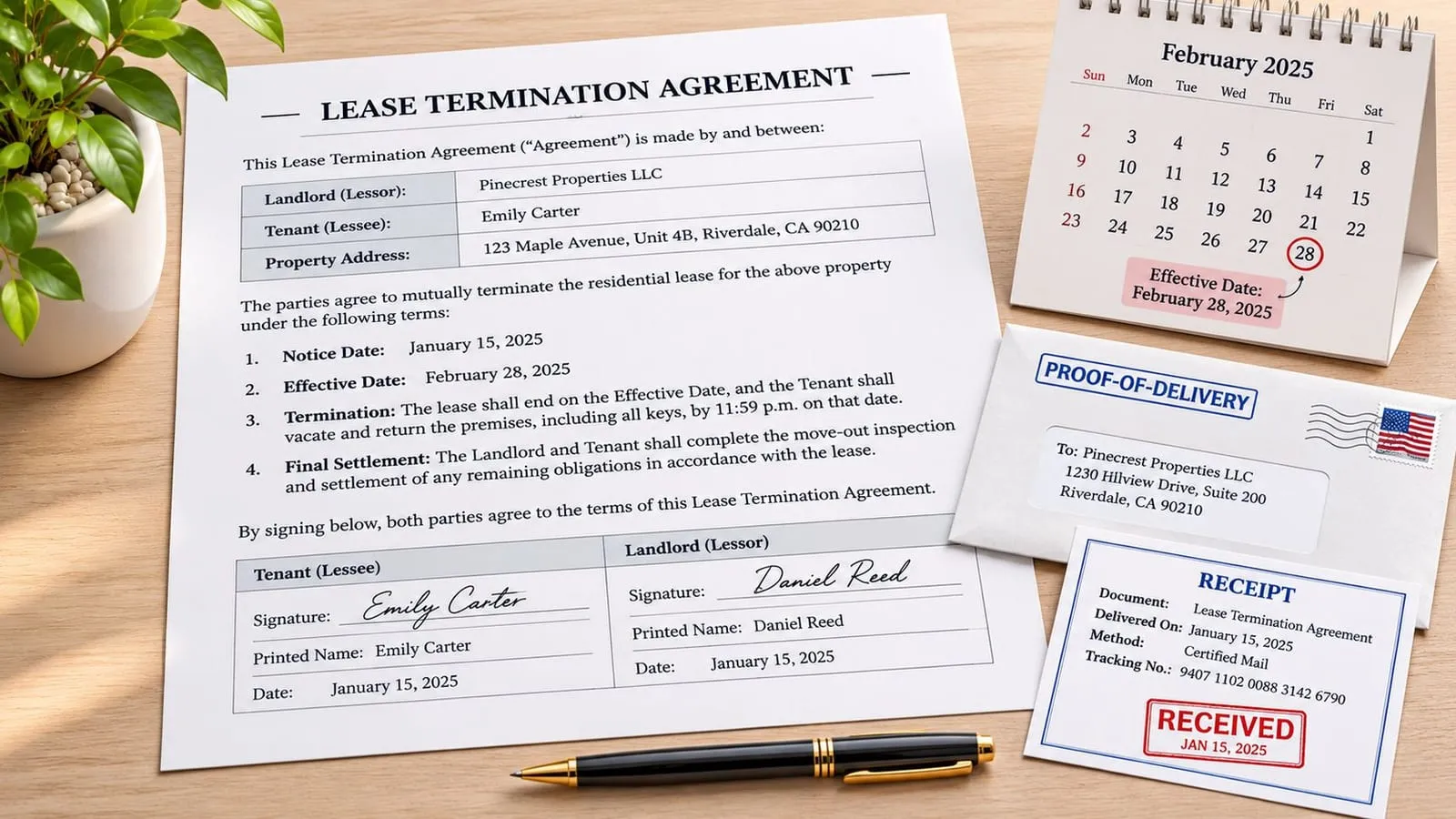
The filled example below uses made-up names, dates and amounts. Replace each one with the details of your lease.
1. Termination. Landlord Jordan Lee and Tenants Sam Rivera and Alex Rivera agree that the lease dated March 1, 2025 for 48 Oak Street, Apt. 3 ends at 11:59 p.m. on January 31, 2026 (the “Termination Date”).
2. Possession. Tenants will remove all belongings and return all keys and access cards to Landlord at 12 Elm Street by the Termination Date.
3. Rent and fee. Tenants will pay rent through the Termination Date. Tenants will pay an early termination fee of $1,500 at signing. Landlord waives rent for any period after the Termination Date.
4. Security deposit. Landlord holds a $2,000 security deposit and will refund or account for it as state law requires. Tenants’ forwarding address is 9 Pine Road, Austin, TX 78701.
5. Release. When Landlord has received the fee in section 3 and possession under section 2, each party releases the other from claims for rent and other charges under the lease for any period after the Termination Date. This release does not cover the security deposit, damage to the unit, or any right that the law does not allow the parties to waive.
6. Voluntary agreement. Each party has read this agreement, has had the chance to get advice, and signs it freely.
Security deposit rules still apply after you sign
The termination agreement does not set the deposit deadline. State law does, and the agreement should point to it rather than invent its own date.
| State | Refund deadline | What else to know |
|---|---|---|
| California | No later than 21 calendar days after the tenant vacates, with an itemized statement | The landlord must tell the tenant in writing of the option to request an initial inspection before move-out |
| New York | Within 14 days after the tenant vacates, with an itemized statement | A landlord who misses the deadline forfeits the right to keep any part of the deposit. Any agreement in which the tenant waives these rights is void |
| Texas | On or before the 30th day after the tenant surrenders the premises | The landlord does not have to refund until the tenant gives a written forwarding address, but the tenant does not lose the refund only for failing to give one |
Two practical points follow. Put the forwarding address in the form itself. Write down the actual move-out and key return date, because all three deadlines run from the day the tenant vacates or surrenders the unit.
What happens without an agreement: the duty to re-rent
A tenant who leaves early without an agreement can owe rent for the rest of the term. Some states reduce that exposure by requiring the landlord to try to re-rent the unit:
- Texas. A landlord has a duty to mitigate damages if a tenant abandons the premises in breach of the lease, and a lease clause that waives that duty is void.
- New York. If a tenant vacates in breach, the landlord must, in good faith, take reasonable and customary actions to rent the premises at fair market value or the lease rate, whichever is lower. A lease clause that removes this duty is void.
These rules matter when you negotiate the termination fee. A tenant in a state with a re-renting duty may not owe the full remaining rent even without an agreement. A landlord gets certainty from a signed agreement: a fixed date and a fixed fee instead of a later claim for damages.
The release clause: what you can and cannot sign away
The release is the part of the form that does the most harm when it is vague. A sentence that releases “all claims of any kind” can sweep in a deposit refund or a repair claim that neither side meant to give up. Name the claims instead, as in section 5 of the sample.
Some rights cannot be waived at all. New York voids any tenant waiver of the deposit rules in General Obligations Law 7-108. In California, for a tenancy covered by the just-cause rules of Civil Code 1946.2, an owner who ends the tenancy for a no-fault just cause must either pay relocation assistance or waive the final month’s rent in writing, in an amount equal to one month’s rent. That section also says any waiver of its rights is void. If a California exit follows a no-fault notice, the form should record which of the two options the tenant received.
When the deal also settles a dispute, such as unpaid rent or damage, the release works like a settlement. A separate settlement agreement can hold those terms.
Make sure the tenant signs freely
A move-out agreement can look voluntary and still be signed under pressure. A study of eviction cases filed in Boston’s housing court from 2013 to 2017 found that move-out agreements were the main procedural route by which tenants were forced to move, as a Law & Social Inquiry study on pathways to eviction sets out. A clear form protects both sides:
- Give the tenant time to read it before signing.
- State in plain words that each party signs freely.
- Say whether the tenant is giving up possession, and by when.
- List any money still owed after the end date.
How to complete the form step by step
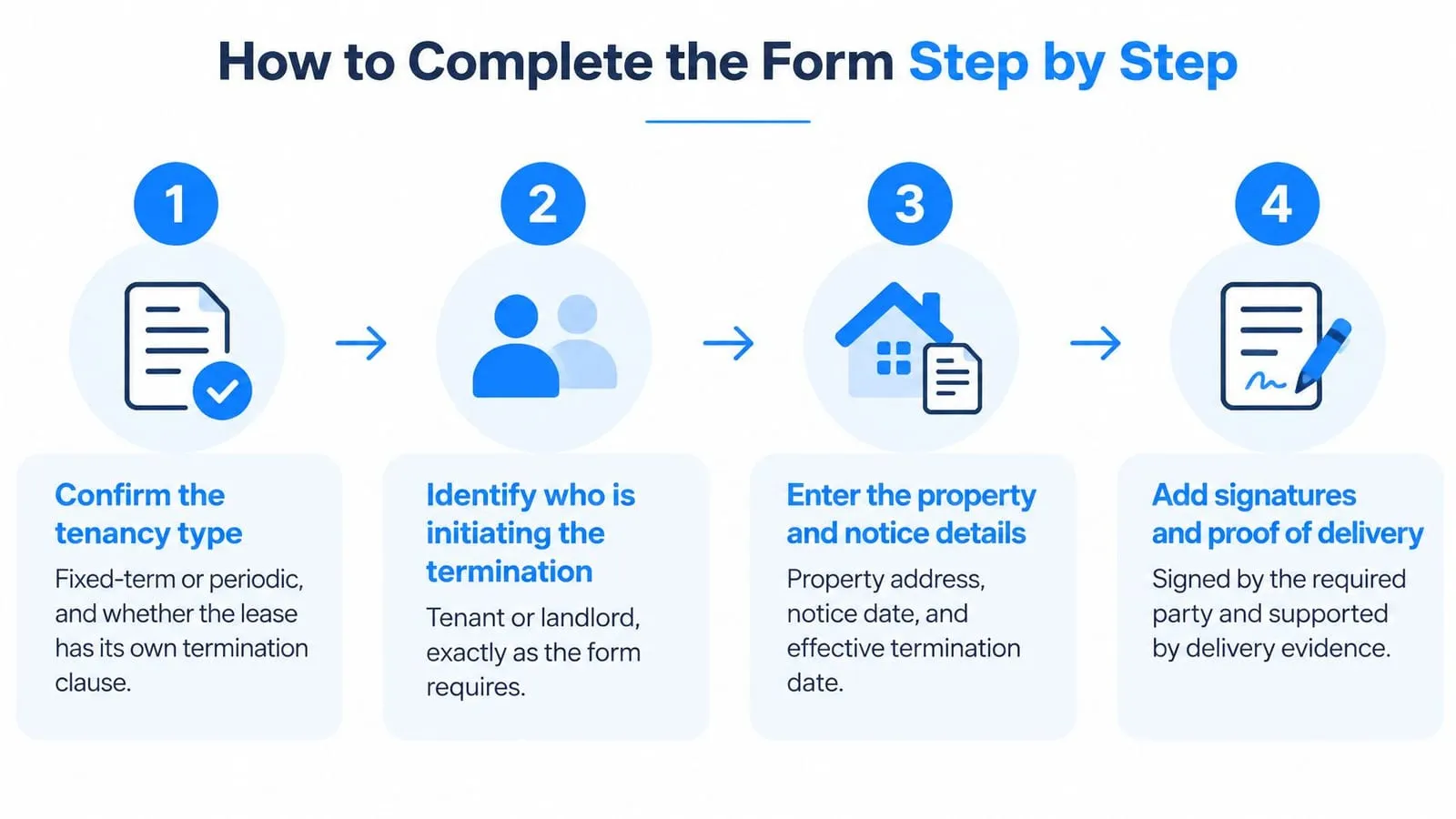
- Read the lease. Check whether it is fixed-term or month-to-month and whether it has an early termination clause or fee.
- Check for a statutory exit. Military orders or family violence can give the tenant a right to leave that does not depend on the landlord.
- Agree the dates. Set one termination date and one possession date. Do not leave the possession date blank.
- Agree the money. Rent through the end date, any fee, and when each amount is due.
- Write the deposit section. Refer to your state’s deposit law and add the forwarding address.
- Write a narrow release. Name the claims each side gives up and the condition that triggers the release.
- Sign and keep copies. Every landlord and every tenant on the lease signs and dates the form. Each side keeps a signed copy.
- Record the handover. Note the date and time the keys come back, and take photos of the unit.
Checklist before anyone signs
- Every person named on the original lease is a party.
- The termination date and the possession date are filled in.
- Rent, the fee and due dates are written as numbers and dates.
- The deposit section refers to state law and has a forwarding address.
- The release names specific claims and keeps out the deposit and non-waivable rights.
- A statutory exit (military or family violence) has been checked.
- Both sides have a signed copy.
If the other party will not sign
A mutual agreement needs both signatures. If the other side refuses:
- Ask what term blocks the deal: the date, the fee, the deposit or the release.
- Offer a revised draft that changes one term at a time, and keep every version.
- Check whether the lease or a statute lets you end the tenancy by notice instead, and follow its notice period.
- If money is in dispute after move-out, put your claim in writing. A demand letter sets out what you are owed and by when.
If you are a landlord who wants to start fresh with a new tenant, draft the next lease from a residential lease agreement template, or the California and Texas versions.
Draft the agreement with Legal Draft
Legal Draft turns the details you already have (the parties, the property, the dates and the money) into an editable lease termination agreement that you can revise clause by clause and export. It is a drafting tool, not a law firm, and it does not give legal advice. For a large sum or a dispute about possession, have a local lawyer review the draft.
Generated with the Outrank tool
Make this document in the app
Legal Draft drafts it for your jurisdiction from a few details. Edit it clause by clause, sign it and export it as PDF or DOCX.
44,000+ custom contracts drafted with Legal Draft
Related templates
Sources
- Cal. Civ. Code 1933 (accessed November 26, 2026)
By the mutual consent of the parties
- Tex. Prop. Code 91.001 (accessed November 26, 2026)
have agreed in an instrument signed by both parties on a different period of notice
- Cal. Civ. Code 1950.5 (accessed November 26, 2026)
No later than 21 calendar days after the tenant has vacated the premises
- N.Y. Gen. Oblig. Law 7-108 (accessed November 26, 2026)
Within fourteen days after the tenant has vacated the premises
- Tex. Prop. Code 92.103 (accessed November 26, 2026)
on or before the 30th day after the date the tenant surrenders the premises
- Tex. Prop. Code 92.107 (accessed November 26, 2026)
for the purpose of refunding the security deposit
- Tex. Prop. Code 91.006 (accessed November 26, 2026)
A landlord has a duty to mitigate damages if a tenant abandons the leased premises in violation of the lease
- N.Y. Real Prop. Law 227-e (accessed November 26, 2026)
take reasonable and customary actions to rent the premises at fair market value
- Cal. Civ. Code 1946.2 (accessed November 26, 2026)
Any waiver of the rights under this section shall be void as contrary to public policy
- Tex. Prop. Code 92.016 (accessed November 26, 2026)
and avoid liability for future rent and any other sums due under the lease
- 50 U.S.C. 3955 (SCRA) (accessed November 26, 2026)
termination of the lease under subsection (a) is effective 30 days